The Unseen Architects of Ecosystems: Why Fungi Demand Unique Ecological Models
Fungi, often relegated to the shadows of ecological discourse, are in fact the unsung heroes and indispensable architects of virtually every terrestrial and aquatic ecosystem on Earth. From the visible mushrooms sprouting after a rain to the vast, intricate networks of mycelia hidden beneath our feet, these organisms embody an astonishing diversity of life forms and ecological roles. Their sheer ubiquity and functional importance, particularly their critical
fungi recycling strategies, are paramount to global nutrient cycles and the very fabric of life. Yet, despite their profound influence, our understanding of fungal ecological strategies often lags behind that of plants and animals, largely because traditional ecological models developed for macro-organisms simply fail to capture the unique nuances of fungal life.
High-throughput sequencing technologies have peeled back the curtain, revealing an astounding, previously underestimated fungal diversity across the globe. This explosion of data, however, presents a significant challenge: how do we categorize and understand this immense variability within a coherent ecological framework? The prevailing theories, honed over decades for creatures with defined body plans and predictable life cycles, struggle when confronted with the diffuse growth, dynamic metabolism, and often cryptic lifestyles of fungi. To truly grasp the future of our ecosystems and enhance their resilience, we must develop new, fungi-specific lenses through which to view their complex and vital roles.
Beyond Body Size: The Unique Challenges of Classifying Fungal Strategies
One of the primary hurdles in applying existing ecological strategy theories to fungi lies in their fundamental biological differences from plants and animals. Concepts like "body size," "individual organism," or "growth architecture," which are foundational to many macro-organism schemes, are problematic when applied to a fungal colony. A single mycelial network can spread for miles, making the definition of an individual ambiguous. This diffuse growth pattern, a signature of fungal life, is critical to their highly efficient
fungi recycling strategies but does not map neatly onto established models.
Furthermore, fungi exhibit remarkable flexibility in their ecological roles, a phenomenon often referred to as "guild shifting." Unlike many animals that are strictly herbivorous or carnivorous, or plants that are solely producers, fungi can switch between nutritional modes. A fungus might act as a saprotroph (decomposer) under certain conditions, then transition to a pathogen or even a symbiont when opportunities arise. This metabolic plasticity and environmental opportunism are incredibly difficult to slot into rigid categorical frameworks. Such adaptability, while key to their survival and their role in resource reallocation, highlights the inadequacy of models that assume fixed ecological niches or life histories.
The Dynamic Nature of Fungal Guilds
Consider the facultative pathogen, a fungus that primarily decomposes dead organic matter but can opportunistically infect a weakened host plant or animal. This dynamic shift underscores a core difference in fungal ecology. Their toolkit of extracellular enzymes allows them to access a vast array of substrates, enabling them to respond to changing resource availability by altering their "guild" – whether as decomposers, mutualists, or parasites. Understanding these shifts is not just an academic exercise; it's crucial for predicting disease outbreaks, optimizing bioremediation efforts, and managing forest health, all of which are intrinsically linked to effective fungi recycling strategies.
The Power of the Mycelial Network: Unpacking Fungi Recycling Strategies
At the heart of fungal ecological impact are their unparalleled
fungi recycling strategies. These organisms are the Earth's primary biological decomposers, orchestrating the breakdown of complex organic matter that would otherwise lock up vast quantities of essential nutrients. Without fungi, ecosystems would quickly become choked with undecomposed plant and animal remains, halting the flow of life-sustaining elements.
Here's how fungi excel as nature's ultimate recyclers:
- Decomposition Mastery: Fungi possess a diverse arsenal of powerful extracellular enzymes that can break down recalcitrant organic polymers like lignin (which gives wood its rigidity) and cellulose. This process, known as saprotrophic decomposition, releases carbon, nitrogen, phosphorus, and other vital nutrients from dead biomass.
- Nutrient Mineralization: As they digest organic matter, fungi convert complex organic compounds into simpler inorganic forms, making these "mineralized" nutrients available for uptake by plants and other microorganisms. This continuous cycling is fundamental to soil fertility and plant growth.
- Carbon Sequestration and Storage: Beyond merely breaking down carbon, fungi play a complex role in carbon sequestration. Their own vast mycelial biomass stores significant amounts of carbon. Moreover, through their interactions with soil and plants, they contribute to the formation of stable soil organic matter, which can lock carbon away for centuries.
- Mycorrhizal Networks: Many fungi form symbiotic relationships with plants, known as mycorrhizae. These extensive underground networks act as sophisticated nutrient highways, facilitating the exchange of water and mineral nutrients from the soil to plant roots, in return for sugars produced by the plant. This represents an efficient, internalized recycling system within ecosystems, boosting nutrient uptake and plant resilience.
Consider the example of white-rot fungi, which are unique in their ability to completely degrade lignin, a feat few other organisms can accomplish. Their enzymatic prowess allows them to unlock the energy and nutrients stored within wood, playing an irreplaceable role in forest ecosystems. The sheer efficiency and scope of these fungal processes underscore their vital contribution to maintaining planetary health and resource availability.
Bridging the Data Gap: Towards Fungi-Specific Strategy Frameworks
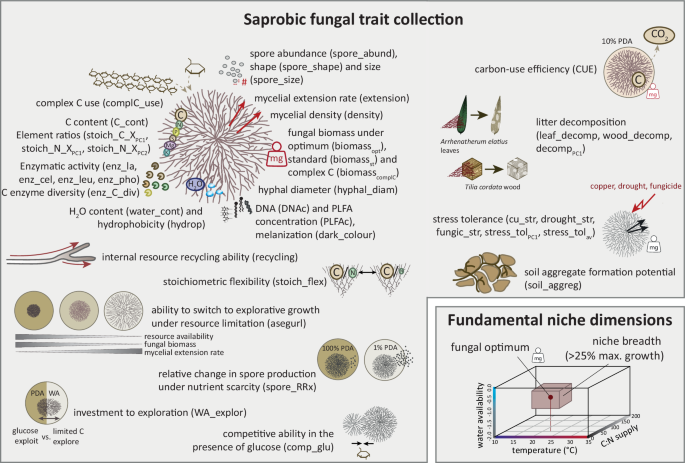
The current lack of comprehensive data on how fungal traits shift across different environments is a major impediment to developing robust, fungi-specific ecological strategy schemes. For macro-organisms, vast datasets exist detailing how traits like growth rate, reproductive output, or competitive ability vary with habitat and resource availability. This kind of nuanced, environmental response data is largely absent for fungi. While high-throughput sequencing has revolutionized our ability to identify *who* is there, we still need to understand *what* they are doing and *how* their strategies adapt.
To move forward, a concerted effort is needed to gather functional trait data for fungi. This includes:
- Quantitative Trait Measurements: Systematically measuring key fungal traits like enzyme production rates, substrate utilization profiles, growth rates under varying temperatures and pH levels, and competitive interactions within communities.
- Environmental Gradient Studies: Designing experiments and field studies to observe how fungal communities and their functional traits respond to gradients in moisture, nutrient availability, carbon sources, and disturbance regimes.
- Integrating 'Omics with Ecology: Combining advanced sequencing data (genomics, transcriptomics, proteomics, metabolomics) with ecological observations and experimental manipulations to link genetic potential with expressed functional strategies in specific environments.
- Standardized Methodologies: Developing and adopting standardized protocols for fungal sampling, cultivation (where possible), and trait measurement to ensure data comparability across studies.
This data-driven approach is essential for building predictive models that can forecast how fungal communities and their vital
fungi recycling strategies might respond to climate change, pollution, and land-use alteration. By understanding the underlying dimensions of fungal ecological strategies, we can better appreciate their contribution to ecosystem resilience and harness their potential for biotechnological applications.
Conclusion: Unlocking the Future of Fungal Ecology
The quest to define and understand fungal ecological strategies is a journey into one of the most dynamic and critical realms of life on Earth. As we've explored, traditional ecological models, while valuable for plants and animals, simply don't do justice to the unique biology, growth architecture, and metabolic plasticity of fungi. Their unparalleled
fungi recycling strategies are not merely a function but a sophisticated interplay of enzymatic prowess, mycelial exploration, and adaptive guild shifting, crucial for maintaining nutrient cycles and sequestering carbon globally. Bridging the current data gaps through focused research, standardized methodologies, and the integration of 'omics technologies with ecological studies will be pivotal. As we deepen our understanding of these enigmatic organisms, we not only gain profound insights into the fundamental workings of our planet but also unlock unprecedented opportunities for innovation in agriculture, medicine, and environmental remediation. The future of ecological science, in many ways, lies beneath our feet, within the extraordinary world of fungi.